A radio link on a fast-moving platform, a low-Earth-orbit satellite or a high-speed train, sees a channel that changes not only across frequency but potentially within an OFDM symbol. Orthogonal frequency-division multiplexing (OFDM) rests on the opposite assumption, that the channel is constant over a symbol so that its subcarriers remain orthogonal. Once the platform moves quickly enough that assumption fails: each subcarrier drifts during the symbol and leaks energy into adjacent subcarriers. The result is inter-carrier interference (ICI), and beyond a certain mobility it forms an error floor that no amount of transmit power can remove.
This impairment has renewed interest in delay-Doppler waveforms, most prominently orthogonal time frequency space (OTFS) modulation, whose joint detector handles the coupling directly. The common conclusion is that OTFS outperforms OFDM in high mobility. This post argues that the comparison behind that conclusion is usually unfair, and that a well-designed OFDM receiver recovers most of the gap. The advantage that survives belongs to the equalizer, not to the modulation.
Why fast fading breaks OFDM
OFDM divides a wideband channel into narrow subcarriers, each of which sees a flat gain as long as the channel is constant over the symbol. Its receiver is then a single complex division per subcarrier. Mobility removes that premise. A path with Doppler shift rotates by over a symbol of duration , and different paths rotate by different amounts, so the composite channel is no longer constant across the symbol. The natural measure of severity is the normalized Doppler,
the ratio of the maximum Doppler shift to the subcarrier spacing . When is a small fraction the subcarriers remain nearly orthogonal; as it approaches and exceeds unity they do not.
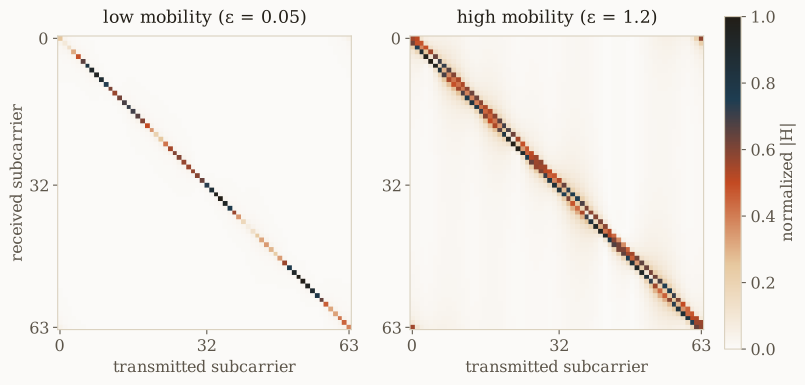
The effect is clearest in the frequency domain. One OFDM symbol and its time-varying channel form an matrix , whose entry is the gain from transmitted subcarrier to received subcarrier . For a static channel is diagonal. For a time-varying one it acquires off-diagonal terms, an ICI band whose width grows with . Figure 1 shows the same channel at low and high mobility. A single-tap equalizer retains only the diagonal and discards the band, and the discarded energy becomes an irreducible error floor.
The delay-Doppler alternative
OTFS takes the opposite approach. Rather than placing symbols on subcarriers, it places them on a delay-Doppler grid and spreads each across the entire time-frequency plane through the Zak transform. In the delay-Doppler domain the doubly dispersive channel becomes a compact, almost time-invariant coupling, a few taps in delay and Doppler that are common to the whole frame. A detector that inverts this coupling jointly, typically a linear minimum mean-square-error (LMMSE) or message-passing detector over the full frame, resolves the interference that defeats the single-tap OFDM receiver [1], [2].
This capability is not free. The joint delay-Doppler detector is a large coupled inversion over the whole frame, iterative rather than per-subcarrier, and it carries full-frame latency. OTFS does not remove the difficulty of a doubly dispersive channel; it relocates that difficulty from the modulation to the equalizer. Whether the trade is worthwhile is precisely the question a fair comparison must answer.
The flaw in the usual comparison
Most published comparisons are constructed against OFDM from the outset. On the OFDM side they place plain OFDM with a single-tap equalizer, and they measure uncoded bit error rate; on the OTFS side they place the full joint detector. Against that OFDM, OTFS shows a clear advantage, but that OFDM is a straw man. No deployed system operates uncoded, and none would meet high mobility with a single-tap equalizer while the ICI band is available to exploit.
A fair comparison must control three things. It must code the bits, because a real link harvests diversity through a channel code and an interleaver rather than from raw symbol decisions. It must match complexity, because a cheap OFDM equalizer set against an expensive OTFS detector is not one experiment but two. And it must match pilots, because tracking a time-varying channel incurs an overhead that both waveforms pay.
A matched-complexity experiment
The three are settled at once by a single observation: both waveforms are unitary precodings of the same time-domain signal. Write the transmitted block as , where carries the data symbols and is a unitary precoder, so that the received samples are
with the physical time-varying channel and the noise. OFDM and OTFS differ only in : a per-symbol inverse DFT for OFDM, and an inverse DFT along the Doppler axis for OTFS. The channel is identical for both. In each waveform’s own domain the channel is , and the same equalizer operation applied to is, by construction, the same computation for both.
This reduces “OFDM versus OTFS” to a controlled experiment. Under the full inversion of the two are identical, which already shows that the modulation alone changes nothing. Under a single tap both floor. Under a banded equalizer at an equal tap budget, a frequency-domain band for OFDM and a delay-Doppler band for OTFS, the comparison is at last even-handed.
The OFDM receiver appropriate to that experiment is a zero-padded OFDM (ZP-OFDM) with a banded, multi-tap frequency-domain equalizer that accounts for the ICI [3], [4]. Rather than retain only the diagonal of , it retains a band of half-width about the diagonal and inverts that band. The band is sized to the mobility,
read from the Doppler spread of the channel estimate, while the coefficients within the band follow the fast fading, tracked from time-domain pilots. The band widens as the platform accelerates and narrows as it slows, so equalizer complexity is spent only where the Doppler requires it.
Where the diversity is won
Under this matched comparison the outcome is consistent, and it holds even in the extreme. At a normalized Doppler of , where the maximum Doppler shift exceeds the subcarrier spacing outright, the ICI-aware OFDM receiver comes within 1 dB of the full delay-Doppler OTFS detector at a fraction of its equalizer cost. It inverts a frequency-domain band of seven taps per subcarrier (half-width ), whereas the joint OTFS detector spans a delay-Doppler band of 189 taps per bin (). Standard single-tap OFDM, on the same channel, never leaves its floor. Figure 2 shows the four receivers together.
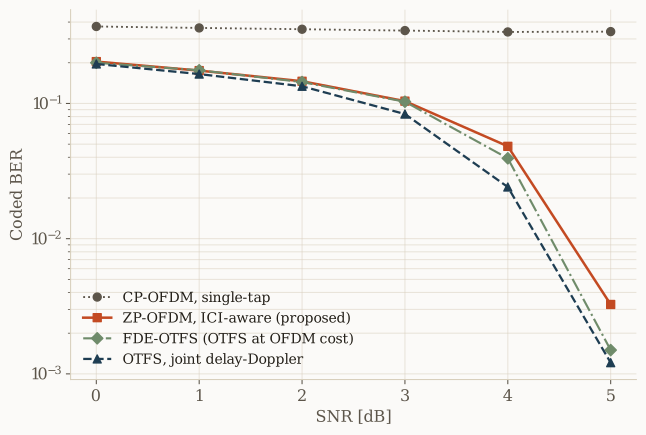
A single control experiment locates the source of the OTFS advantage. Take the OTFS waveform, its full delay-Doppler spreading intact, and equalize it with the cheap per-symbol band rather than the joint detector. Its curve does not follow joint OTFS; it coincides with the OFDM curve. The spreading, on its own, confers no gain. The advantage that OTFS displays comes from the joint equalizer that the spreading makes convenient, not from the spreading itself.
What remains is a clean division of labor. A doubly dispersive channel carries a fixed amount of diversity. OTFS harvests it in the equalizer with a complex joint detector, while coded OFDM harvests it in the code and interleaver and keeps the equalizer simpler. Both reach a similar diversity order. The question is therefore not which waveform is fundamentally superior but where to spend the complexity. OFDM spends it in components a modern link already contains: the code and the pilots.
Why it matters
This is not merely an academic question. High-mobility OFDM is already in service: 5G non-terrestrial networks (NTN) operate OFDM against the several-kilohertz Doppler of low-Earth-orbit satellites [5]. And in 2025 the 3GPP standardization effort settled the 6G waveform in OFDM’s favor, adopting cyclic-prefix OFDM in the downlink and adding discrete Fourier transform spread OFDM as an uplink option. A departure from OFDM was available, and was not taken.
Against that background the result is reassuring rather than surprising. If a well-designed equalizer closes most of the gap to OTFS, then the flexibility that makes OFDM the incumbent, its clean multi-user MIMO, its orthogonal frequency-division multiple access, its scheduling granularity, and its backward compatibility with deployed hardware, is worth retaining. The honest reading of the delay-Doppler literature is not that OFDM must be replaced, but that it needs a better receiver in high mobility, a far more modest requirement.
None of this is the final word. This comparison aims to provide a grounded baseline. The delay-Doppler view remains an elegant way to reason about doubly dispersive channels. But for an engineer deciding where to invest, the lever is the equalizer, not the waveform. The full derivation, the matched-complexity framework, and reproducible code are in the preprint and repository [6].
References
[1] R. Hadani, S. Rakib, M. Tsatsanis, A. Monk, A. J. Goldsmith, A. F. Molisch, and R. Calderbank, “Orthogonal time frequency space modulation,” in Proc. IEEE Wireless Communications and Networking Conference (WCNC), 2017, pp. 1–6.
[2] P. Raviteja, K. T. Phan, Y. Hong, and E. Viterbo, “Interference cancellation and iterative detection for orthogonal time frequency space modulation,” IEEE Trans. Wireless Commun., vol. 17, no. 10, pp. 6501–6515, 2018.
[3] L. Rugini, P. Banelli, and G. Leus, “Simple equalization of time-varying channels for OFDM,” IEEE Commun. Lett., vol. 9, no. 7, pp. 619–621, 2005.
[4] Y. Mostofi and D. C. Cox, “ICI mitigation for pilot-aided OFDM mobile systems,” IEEE Trans. Wireless Commun., vol. 4, no. 2, pp. 765–774, 2005.
[5] 3GPP TR 38.811, “Study on New Radio (NR) to support non-terrestrial networks,” 3rd Generation Partnership Project, 2020.
[6] K. Dovelos, “OFDM with adaptive ICI-aware equalization for doubly dispersive channels,” preprint, 2026.